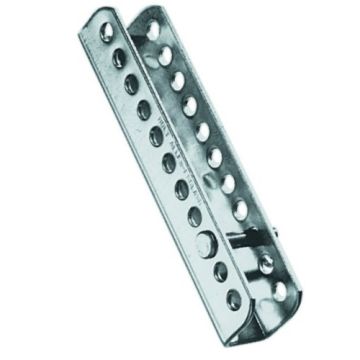
GP14 Rig Tuning Guide: Chainplate Adjusters & Mast Gate Chocks
Comprehensive Technical Reference
1. Core Principles
Your two main geometric controls:
| Control | Function |
|---|---|
| Vertical chainplate adjusters (shroud pins/channels) | Set mast rake and baseline rig tension. Moving pins up makes the mast more upright (less rake, tighter forestay, flatter sails). Moving pins down increases rake (softer forestay, more power). |
| Mast-gate chocks | Fine-tune mast bend at deck level. Adding or removing them changes how freely the mast can bend under load, which directly affects mainsail depth and leech tension. |
The adjusters provide the coarse tuning; chocks provide the fine control.
2. Interaction Summary
| Adjustment | Mast Rake | Forestay | Mast Bend | Sail Shape | Typical Use |
|---|---|---|---|---|---|
| Pins down (lower hole) | More rake aft | Softer | More bend | Fuller | Light winds (power) |
| Pins up (higher hole) | More upright | Tighter | Less bend | Flatter | Strong winds (control) |
| Add front chocks | Mast straighter | Tighter | Less bend | Deeper main, tighter leech | Add power |
| Remove front chocks | Mast free to bend | Looser | More bend | Flatter main, open leech | Depower |
| Add behind-mast chock | Pushes mast forward | Slightly tighter | More prebend | Flattens main further | Max depower |
3. Recommended Starting Settings
(Assuming Selden or Superspars mast; measure mast rake from top of mast to top of transom deck)
| Wind Strength | Shroud Pin Hole (count from top) | Mast Rake | Front-of-Mast Chocks | Behind-Mast Chocks | Rig Tension (Loos Gauge) | Performance Aim |
|---|---|---|---|---|---|---|
| Light (< 8 kt) | 4 – 5 (lower down) | ~6900 mm | 2 thin (≈ 10 mm total) | None | 18 – 20 (~300-350 lb) | Maximum drive and height in lulls |
| Medium (8–14 kt) | 3 – 4 | ~6875–6885 mm | 1 thin (≈ 5 mm) | None | 22 – 24 (~400 lb) | Balanced height vs speed |
| Fresh (14–18 kt) | 2 – 3 | ~6860–6870 mm | None | Optional 1 thin | 24 – 26 (~420-440 lb) | Depowered but still responsive |
| Heavy (> 18 kt) | 1 – 2 (top) | ~6850–6860 mm | None | 1–2 thin | 26 + (~440-450 lb) | Maximum control and flat sails |
4. Step-by-Step Tuning Routine
1. Set chainplate pins for expected wind.
Lower for light; higher for heavy.
2. Step mast, attach shrouds, and tension jib halyard to sailing load.
3. Insert chocks in mast gate according to wind:
- • Light → more front chocks (stiffen).
- • Breeze → remove front chocks (let bend).
4. Check rake using main halyard to transom.
5. Sight up mast for smooth continuous curve—no sharp kink at deck.
6. Sail test:
- • If over-powered → remove one front chock.
- • If under-powered → add one front chock.
5. Diagnostic Guide (On-Water Feel → Adjustment)
| Observation | Cause | Remedy |
|---|---|---|
| Boat feels heavy, heeling early | Mast too straight, leech tight | Remove front chock |
| Boat lacks drive, slow after tacks | Mast too bent, sails flat | Add front chock |
| Poor pointing, jib luff sagging | Forestay too soft | Add front chock or raise pins |
| Excess weather helm | Too much rake | Raise pins one hole |
| Boat lifeless / lee helm | Mast too upright | Lower pins one hole |
| Still over-powered after chock removal | Main too full | Add thin chock behind mast to induce extra prebend |
6. Complementary Controls
| Control | Adjustment | Purpose |
|---|---|---|
| Vang / Kicker | Increase to flatten main & control twist in breeze | Major depowering tool once chocks set |
| Cunningham | Use in breeze to flatten luff | Maintain shape as mast bends |
| Outhaul | Tighten as wind builds | Flatten foot of main |
| Jib Halyard / Rig Tension | Adjust before sailing | Sets base forestay tension |
| Jib Cars | Move aft in breeze, forward in lulls | Controls jib leech twist & slot width |
7. Key Takeaways
Chainplate pins = rake & tension (coarse tuning).
Chocks = mast bend & leech control (fine tuning).
As wind increases → raise pins and remove front chocks.
In extreme breeze → add a thin behind-mast chock to promote prebend and flatten main.
Always measure and log your own rake/tension/chock combinations for repeatability.